
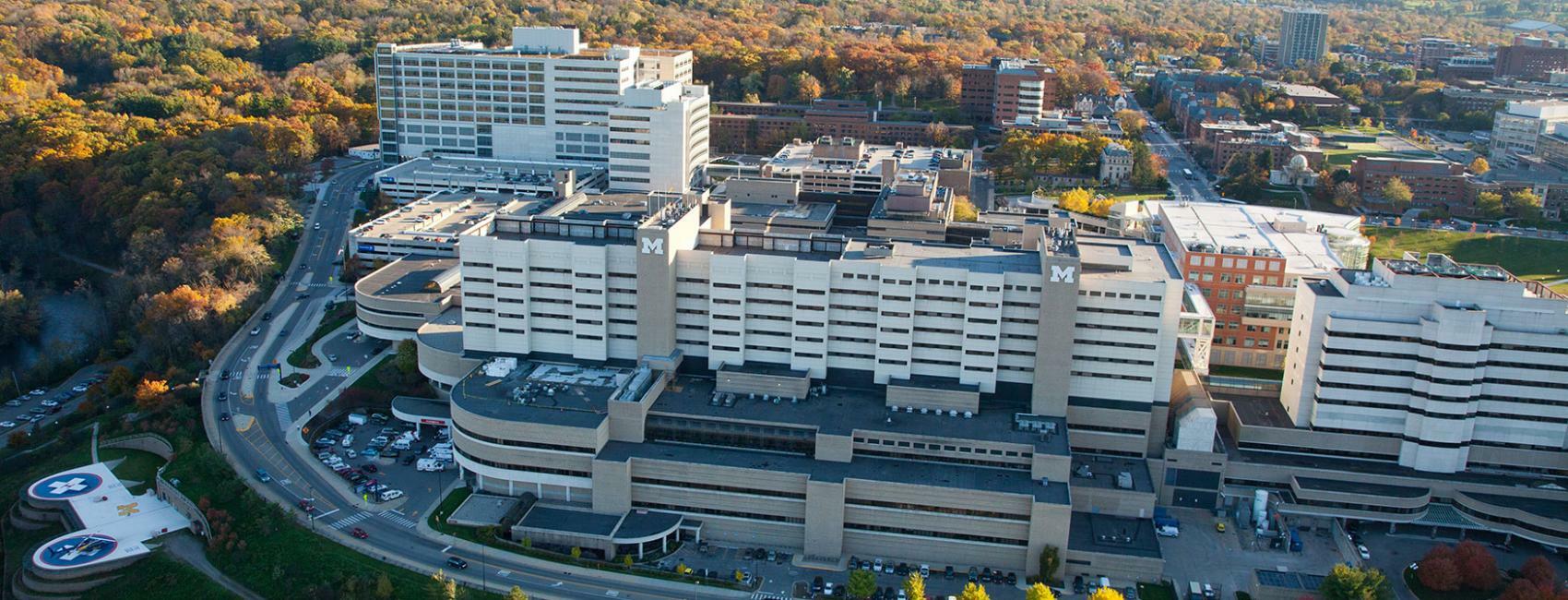
University of Michigan Medical School
When the University of Michigan founded its medical school in 1850, it immediately assumed a leadership role in American academic medicine.
We were the first medical school in the United States to recognize the importance of, and to build, a university hospital for physician instruction. We were also a pioneer in the introduction of the modern science-based curriculum, and were among the first schools to change the role of the student from passive observer to active participant in the learning process through high-caliber laboratory instruction and clerkships.
We also enjoy a unique place in the annals of education as one of the very first major medical schools to admit female students and minorities. In the more than 165 years of service to students, these firsts, and many more, have galvanized our reputation as one of the nation’s premier public research-oriented medical schools.
The Medical School was the University's first professional school, and since graduating its first class of six students in 1851 — a group that paid a mere $5 for two years of medical education — we have become a leader in preparing the physicians and scientists of the future.
Our Mission

Our faculty, partnered with a dedicated staff, is committed to creating the future of health care through discovery. This includes offering a medical education that sets the standard for discourse, intellectual rigor and creativity. Throughout our 20 clinical and nine basic science departments, we are committed to a single mission:
“To transform health through bold and innovative education, discovery, and service.”
We graduate approximately 170 physicians annually, strengthening a body of UMMS alumni more than 20,000 strong. Our alumni include Nobel Prize winners, including Marshall Nirenberg (Ph.D. 1957), who won the 1968 prize in physiology or medicine for his work on the genetic code and its function in protein synthesis; and Stanley Cohen (Ph.D. 1948), who received the honor in 1986 for discoveries leading to the understanding of mechanisms that regulate cell and organ growth.
Former U.S. Army Surgeon General Eric B. Schoomaker (M.D. 1975) is a Medical School alumnus, as are several leaders of Fortune 500 companies, and faculty who occupy top posts at the best educational and research institutions around the world. In fact, we rank second nationally in the number of alumni who have gone forth to become productive faculty members at academic institutions across the country.

During their time here, our students have access to unparalleled research opportunities. The U.S. News & World Report consistently ranks our Medical School among the top research schools nationally. Our scientists seek understanding of the origins of illness and disease, and they work hard in all facets of science to move forward in ways that improve quality of life.
That’s why organizations such as the National Institutes of Health (NIH) heartily support our work. Each year, almost 70 percent of the University’s total NIH funding — and nearly half of all sponsored activity — is awarded to the Medical School.

Many research awards are made to support investigation in the basic sciences — one of our strengths. Our basic science researchers study the most fundamental elements of life — what makes a cell divide and conquer, the makeup of genes, the mysteries of DNA, and so much more — to advance existing scientific knowledge.
Our students are involved in many research activities, and are given the freedom and resources to pursue those lines of inquiry that are of greatest interest to them. Many will play a crucial role in discoveries that will make an impact worldwide.

We are committed to being a school with global impact. Our students have access to information from around the world, unconstrained by time or geography.
Across the four-year curriculum, nearly half of our students engage in global activities through programs such as Global REACH, and many other opportunities exist for our students to learn and serve around the world.

Students also play a key role in the third arm of our tripartite mission — excellence in patient care. Our Medical Group includes nearly 1,800 U-M faculty physicians who care for patients at three U-M hospitals, 40 U-M health centers and other facilities throughout the state of Michigan. It is in these same facilities that our students will take their education from learning to practicing.

In more than 160 years of service to the University, State of Michigan, and the world, we have known how to put patients first, when to push the boundaries of science and medicine, how to design successful curricula, and how to reward our faculty, students and staff for their everyday excellence.
Together, we are making The Michigan Difference in medicine.
About
- Mission/Strategic Pillars
- Strategic Plan (2019-2024)
- School Leadership
- Featured News
- Key Initiatives
- Faculty Profiles
- Awards
- Facts & Figures
- Departments & Centers
- Living in Ann Arbor
- Mini Med School
- Contact Us
- LCME Self-study

MEDICAL SCHOOL
- Departments & Centers
- Faculty Affairs & Development(link is external)
- Office of Research(link is external)
- Alumni(link is external)
- UofMHealth.org(link is external)
- For Health Providers(link is external)
- Health Research Studies(link is external)
- Report Misconduct(link is external)

Support Medicine at Michigan(link is external)
Fund medical students' education and residents' training, invest in faculty, or support a specific medical initiative.
Get the Latest COVID-19, Research, and Wellness News from our Experts(link is external)
Sign up to have the Michigan Health Lab and Michigan Health e-newsletters delivered straight to your inbox.
How to Apply
Education
M.D. PROGRAM
The Michigan M.D. Program is built around your journey to become the physician you want to be, incorporating systems-based basic science curriculum, applied learning in the clinical setting, mentored personal and professional growth, a balanced quality of life, and more time and flexibility to pursue your passions in your third and fourth years.
M.D. AdmissionsM.D. LINKS
Curriculum HighlightsAdmissions Requirements
Medical Student Demographics
Paying for Med School
Match List
M.D. Profiles
35 AAMC Questions Answered
M.D. / PH.D. PROGRAM
The Medical Scientist Training Program (MSTP) prepares physician scientists for careers in academic medicine with a focus on biomedical research. More than just an M.D. and a Ph.D. spliced together, our program offers comprehensive support and guidance, integrating academic excellence and flexibility to help you reach your career goals.
M.D. / Ph.D. ProgramM.D. / PH.D. LINKS
M.D./Ph.D. AdmissionsDoctoral Programs
Curriculum
Faculty & Departments
UM-SMART Undergrad Summer Research Program
PH.D. PROGRAMS
As an interdisciplinary gateway, the Program in Biomedical Sciences (PIBS) at Michigan gives you access to 13 Ph.D. programs through one application. Students rotate in labs of their choice throughout the first year to discover an ideal mentor and project match.
Ph.D. AdmissionsPH.D. LINKS
Application OverviewGraduate Programs
PIBS Curriculum
Research
Interest Form(link is external)
POSTDOCTORAL FELLOWS
Postdoctoral fellows enrich the robust research enterprise at the University of Michigan Medical School. We place a high value on your deep expertise and the contributions you will make while you train with us. Explore the wide array of career and professional development opportunities that await you.
Prospective PostdocsPOSTDOC LINKS
Finding a PositionInternational Postdocs
RESIDENCY & FELLOWSHIP
More than 9,000 M.D.s and M.D./Ph.D.s have completed their residencies and/or fellowships at the University of Michigan Medical School. That’s 9,000 individuals who have been able to take advantage of Michigan’s incredible array of resources in the areas of education, patient care and research.
Residency & FellowshipRESIDENCY & FELLOWSHIP LINKS
Medical School DepartmentsFacts & Figures
About Ann Arbor
PREMED & RESEARCH POSTBAC PROGRAMS
Non-degree programs at the U-M Medical School offer learning opportunities to undergraduate students and postbaccalaureate applicants who may hope to apply to an M.D., M.D./Ph.D., or Ph.D. program in the future.
Postbac ProgramsPOSTBAC LINKS
Postbac MEDPREPPostbac Research Education Program (UM PREP)
PREP Interest Form(link is external)
OTHER PROGRAMS
Master's Programs
Visiting M.D. Students
Undergrad Summer Research
Continuing Medical Education and Lifelong Learning(link is external)
Academy of Medical Educators
Source: https://medicine.umich.edu/medschool