

University of Rochester Medical School
MD Program
Mission
We improve the health of individuals and populations through an innovative medical education program that emphasizes inclusion, humility, and personal growth.
Vision
We inspire diverse learners to become compassionate leaders in medicine and science by emphasizing collaboration, discovery and excellence.
Values
The URSMD MD program embraces the IICARE values of Integrity, Inclusion, Compassion, Accountability, Respect and Excellence.
The University of Rochester School of Medicine and Dentistry (URSMD) is dedicated to training future humanistic physicians who are leaders in clinical medicine, research, and administration. The “Double Helix Curriculum—Translations and Transitions” integrates clinical and basic science throughout four years emphasizing the Biopsychosocial Model. Our curriculum includes instruction in the pillars of Collaborative Care, Technology in Medicine, and Professional Identity Formation. Our instruction utilizes a variety of modalities including problem based learning, small group experiences, simulation, and team based learning. Medical Humanities transcend our curriculum to facilitate education in innovative and creative ways. Outcomes assessments guide students in achieving excellence.Numerous research opportunities, community service, elective pathways, and international opportunities assist students in achieving their long-term educational and career goals. The school is committed to setting the highest standards in medical education and serving as a national model for innovation and continuous improvement in medical student education. We welcome your exploration of our website which will allow you to appreciate the Rochester difference.
Double Helix Curriculum—Translations and Transitions
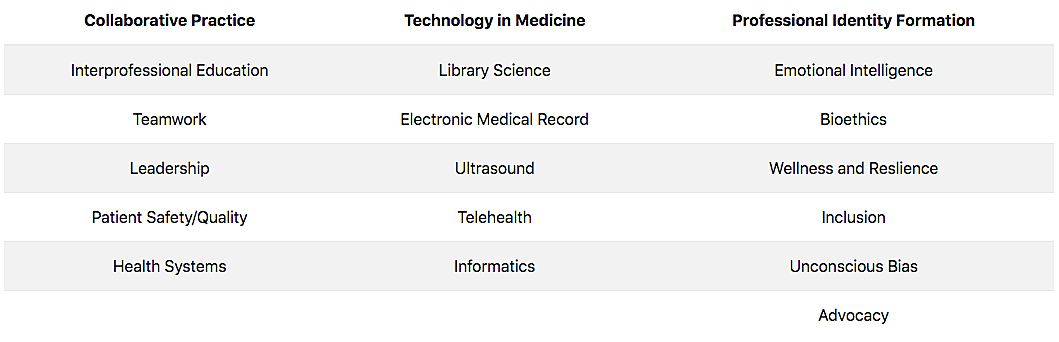
Over four years, the “Double Helix Curriculum—Translations and Transitions” teaches the scientific foundations and clinical medicine and how they translate to exceptional care. The scientific foundations of medicine over the four phases of the DHC-TT include basic, social, and informational sciences. Earlier in the curriculum the basic sciences are emphasized and as the curriculum progresses, the social and informational sciences become the more prominent scientific foundations content. Students develop communication and clinical skills quickly with our early clinical exposure. Drawing upon the University motto of “Meliora—ever better”, Meliora in Medicine is a curriculum thread across the four years that includes our Medical Humanities and three content pillars: Collaborative Practice, Technology in Medicine, and Professional Identity Formation. Ample elective time enables each student to tailor their experiences to meet educational and career goals. Guided by our educational program objectives and emphasizing Rochester’s Biopsychosocial Model, we educate and train outstanding physicians who are prepared to practice medicine caring for diverse patients in a dynamic, changing healthcare environment.
Using an iPad delivery platform, instructional methods include Problem Based Learning, Team Based Learning, large and small group skills sessions. Standardized patients and simulation provide direct hands on experiences. Clinical options in urban, rural, ambulatory and inpatient settings provide rich, diverse clinical experiences.
The Double Helix Curriculum—Translations and Transitions highlights and facilitates the transition of accepted applicant to medical student to physician entering graduate medical education. Our Advisory Dean program provides students with access to a myriad of resources, academic and career counseling, wellness and resilience, and professional development. Facilitating the transitions begins with orientation and continues with defined activities throughout the curriculum culminating in our specialty specific competencies and capstone course in the final phase.
Our graduates are successful in careers encompassing academic medicine, rural medicine, research, administration, and community advocacy.
Phases


Meliora in Medicine
Source: https://www.urmc.rochester.edu/education/md/admissions/contact.aspx