

Warren Alpert Medical School of Brown University
Our Mission
To support and promote the health of individuals and communities through innovative medical education programs, research initiatives, and clinical excellence in service to society and to improve the health and wellness of all.
Our Vision
We envision attracting, training, and sustaining diverse individuals who will work together to lead locally, nationally and internationally renowned transformative and socially responsible medical education, research, clinical care, and advocacy. We will inspire and cultivate physician scholars and leaders who positively impact the health of people and society.
Our Values
- Humanism and compassion
- Integrity, accountability, and collaboration
- Creativity, innovation, and discovery
- Inclusiveness, diversity, and equity
- Dedication to anti-racism
- Social responsibility, both locally and globally
- Community engagement and service
- Commitment to professional development
These statements were developed in 2019 with feedback from administrative and academic leaders, representatives of the faculty, and the Medical Student Senate.
Faculty and students are required to review all school-wide policies and procedures.
Diversity
Multicultural perspectives are critical to the success of The Warren Alpert Medical School. They enrich educational understanding, foster-culturally appropriate patient care, and enhance trust in research.
The Making of a Medical School
The history of medicine in Rhode Island and the history of The Warren Alpert Medical School of Brown University have been deeply interconnected for two centuries. They have never been more closely aligned than they are today, when the medical school is the heart of a major academic medical center embracing seven hospital affiliates in a network of connections and collaborations that extends throughout Rhode Island and beyond.
1811
BROWN BECOMES THE THIRD UNIVERSITY IN THE NATION TO OFFER ACADEMIC MEDICAL EDUCATION
In its brief 16-year history, this early program attracted some illustrious teaching physicians who went on to play roles on the national scene, participating in the founding of the American Medical Association and helping set the first national standards for medical education. Locally, they helped found and lead the Rhode Island Medical Society and worked with their colleagues to make Rhode Island Hospital a reality, a goal they achieved after decades of persistent advocacy. The most renowned of them, Dr. Usher Parsons, became Rhode Island Hospital’s first president.

Public calls for reviving medical education at Brown began immediately after the school was closed in 1827, and they recurred over 136 years. The appeals came from ordinary Rhode Islanders, from physicians, from hospitals, and from political leaders, all of whom recognized the benefits a medical school would bring to the state – in the caliber and scope of health care, in the number and expertise of physicians, in the growth of hospital programs and technologies, and in the local economy.
The Mid-20th Century
In 1963, the calls were answered; the first steps were taken to remove Rhode Island from the small roster of states without a medical school. Momentum was provided by funding from the state and federal governments and from private foundations, as well as from the University. Dr. Pierre Galletti, the University’s first dean of biology and medicine, Dr. Milton Hamolsky, chief of medicine at Rhode Island Hospital, and Professor of Biology J. Walter Wilson were among the prime movers in the creation of the Master of Medical Science program.Although initially a continuum of four years of undergraduate study and just two of graduate study in basic science, the program sparked immediate growth in the Brown faculty and in the staffs of collaborating hospitals, as joint appointments and new training programs were created.
By 1969, when the first Master of Medical Science class graduated, the program was already changing the landscape of medicine in the state: accelerating the delivery of new techniques and technologies to the patient bedside, attracting more and better-qualified residents to Rhode Island’s hospitals, encouraging more young doctors to practice in the state, and stimulating more Rhode Island students (who had been the most poorly represented in the nation in medical schools) to study medicine.
The hospitals and the community needed more, and soon a four-year medical program developed under the leadership of Dr. Stanley Aronson, founding dean of medicine, Dr. David Greer, associate and later second dean, and a cohort of medical students and faculty committed to a novel re-imagining of medical education. Together, they designed a program to prepare physicians committed to excellence in patient care and guided by humanistic values – the foundation on which The Warren Alpert Medical School of today is built.
1972
BROWN'S FULL MEDICAL DEGREE PROGRAM IS RE-LAUNCHED
The re-launch of the medical degree program included clinical clerkships at seven affiliated hospitals and an infusion of new specialists, new laboratories, new research programs, and new clinical services.Since the first MD class graduated in 1975, Brown’s medical school has expanded its faculty and programs and class size; residencies and specialties and technologies have proliferated; partnerships have evolved and deepened; and research initiatives have burgeoned.
 Play
Dean Emeritus Stanley Aronson, MD, was appointed to Dean of Medical Affairs in 1973, and was Dean of Medicine from 1976 to 1981.
Dean of Medicine Emeritus David S. Greer led the Medical School from 1981 to 1992.
 Play
Dean of Medicine Emeritus Donald March served as dean from 1992-2002.
 Play
Richard Besdine, the David S. Greer, MD, Professor of Geriatric Medicine, led the Medical School as interim dean from 2002 to 2004.
 Play
Professor of Medical Science Eli Y. Adashi, MD, (right) pictured with President Emerita Ruth Simmons and Neel Shah ’04 MD’09, led the Medical School from 2005 to 2008.
 Play
Professor of Medical Science Eli Y. Adashi led the Medical School from 2005 to 2008.
 Play
Professor of Medical Science Edward Wing served as dean from 2008 to 2013.
 Play
Senior Vice President for Health Affairs Jack A. Elias, MD, has been the dean of biological sciences since 2013.
The Modern Era
Today, Brown’s Division of Biology and Medicine – composed of The Warren Alpert Medical School and the Program in Biology – is home to numerous centers of excellence in biomedical research and clinical care. Since 2013, external funding for research has increased 109 percent. The Medical School and its teaching hospitals garnered more than $215 million in research funding in 2019.A world-class campus-based and hospital-based faculty, totaling more than 2,300 members -- 59 percent of all physicians in Rhode Island -- teaches in five basic science departments and 14 clinical departments. They teach medical students and residents in 27 residency programs in affiliated hospitals, among which Rhode Island Hospital, the school’s first clinical site, is the principal teaching affiliate. Training opportunities are amplified by a large network of Rhode Island physicians who serve as community-based clinical faculty.
The Warren Alpert Medical School attracts a highly diverse body of students from throughout the United States and abroad through two major routes: the Program in Liberal Medical Education, an eight-year continuum of undergraduate and medical studies; and the standard route of admission, open to applicants from outside the Brown community. These students are among the best prepared and most talented in the nation. They collaborate with faculty in an educational experience that is grounded in an innovative competency-based curriculum, enriched by a vigorous research enterprise, and shaped by the commitment to humanistic medicine that has been the school’s hallmark for four decades.
2011
THE NEW HOME OF THE WARREN ALPERT MEDICAL SCHOOL OPENS ITS DOORS
Who Was Warren Alpert?

In January 2007, The Warren Alpert Foundation made a pledge of $100 million to Brown Medical School; in accepting the gift, the Brown Corporation voted to re-name the school in the donor’s honor: The Warren Alpert Medical School of Brown University. The Foundation’s commitment was only the second gift of its size the University had ever received, and much of it was earmarked for building a home for the medical school. The remainder of the gift established the The Warren Alpert Scholars Program, which provides annual scholarships for medical students; created new endowed professorships; and established an endowed fund for faculty innovation and biomedical research.
This would be the last major gift the foundation made during Warren Alpert's lifetime; he died later that same year, at the age of 86. Mr. Alpert was an entrepreneur whose Warren Equities, Inc. grew to become one of the top 400 privately owned companies in the US. It operated the Xtra Mart brand of gas and convenience stores, in addition to holding interests in real estate and transportation. Mr. Alpert established his foundation in 1986 to reward the effort of scientists working to cure disease. The foundation awards the prestigious Alpert Prize, which honors the world's top physicians and scientists.
The foundation made an additional $27 million gift in 2016, with which Brown established the Warren Alpert Physician-Scientist MD/PhD and Advanced Training Program. MD/PhD programs are an essential component of a disease-focused medical school, and relaunching the program at Brown was a key part of the strategic plan for the Division. The Warren Alpert Foundation’s funding made it possible to underwrite the tuition of all four years of medical school for every MD/PhD student.
The Medical School Today
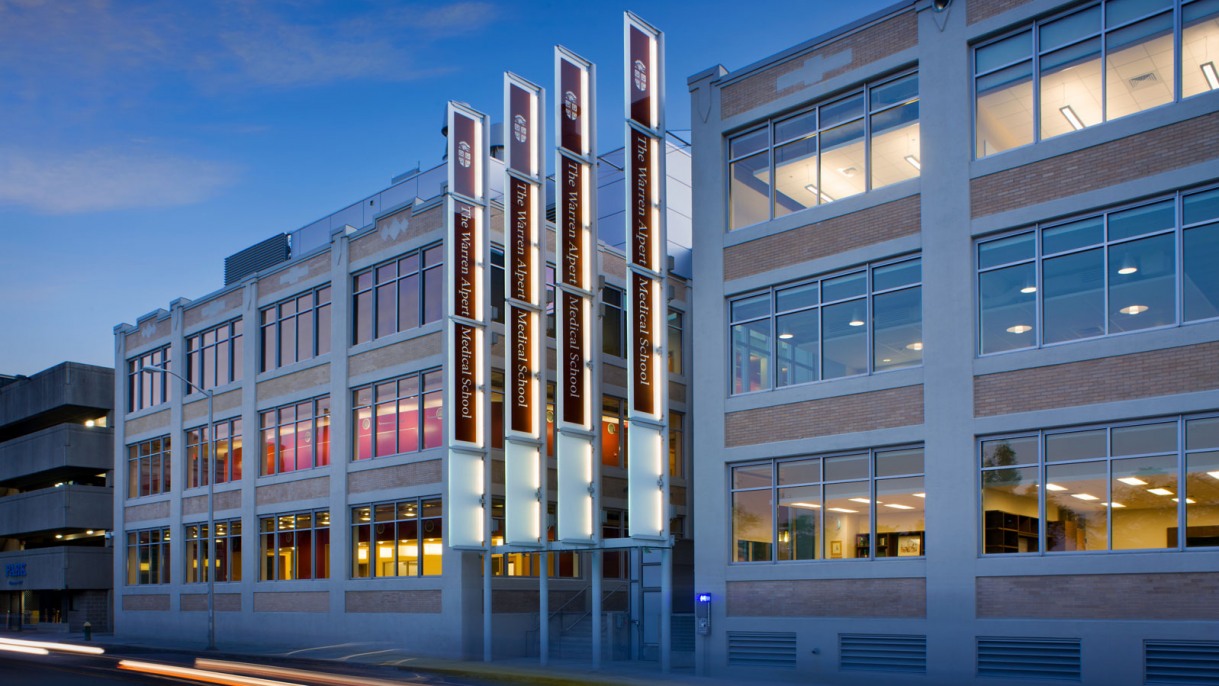
The Warren Alpert Medical School building at 222 Richmond Street in Providence's Jewelry District was the first facility to co-locate the core academic program and administrative offices. Among its immediate effects was the ability of admitting more medical students – increasing class size by 20 percent, to 120 – and introducing new academic programs. The building represented a leap forward in Rhode Island’s growth as a major center for biotechnology and medicine, a development that Brown’s research enterprise has helped generate. It was also among the first of many Brown programs to step off College Hill and relocate in the Jewelry District. Within 10 years, Brown had moved almost all of its administrative offices to the South Street Landing building across from the Medical School, and become an anchor tenant in the Wexford Innovation Center just a block away.During the tenure of Dean Jack A. Elias, MD, who led the Division of Biology and Medicine from 2013 to 2022, the Medical School's research enterprise flourished. Research funding grew more than 130 percent and a number of new integrated research centers were formed. The number of physician-scientists on the faculty has grown commensurately, fostering greater emphasis on translational and disease-focused research.
In March 2022, physician-scientist Mukesh K. Jain, MD, began his appointment as the eighth dean of medicine and biological sciences at Brown University.
The Warren Alpert Medical School has evolved into one of the best medical schools in the country, with a vigorous and growing research community, and outstanding clinical care. Its principal mission – to train excellent physicians equipped to improve the health of individuals and communities – is inseparable from its commitment to create an academic medical enterprise of the first rank in Rhode Island.
VISIT PAGE
BROWN UNIVERSITY
Providence RI 02903 401-863-1000